

How to Tell if Vintage Jewelry Is Real Sterling Silver
One of the quiet pleasures of collecting vintage jewelry is discovering that a piece you already love is actually solid sterling silver.
Vintage sterling has a character all its own. Years of wear can create a beautiful patina, details were often finished by hand, and depending on the maker and era, identifying marks can sometimes be surprisingly difficult to find.
But how can you tell genuine sterling silver from silver plate, silver-tone metal, or another look-alike?
Here are some of the first things we look for when sourcing and researching vintage jewelry for This & That Vintage.

1. Look for the Hallmark
The first place to start is with the markings.
Sterling silver jewelry is commonly stamped somewhere discreet: on the inside of a ring, near a clasp, on the back of a brooch or pendant, or along the interior of a bracelet.
Some of the most common marks to look for include:
- 925
- STERLING
- STER
- .925
The number 925 indicates that the piece is 92.5% pure silver, which is the standard composition for sterling silver.
Don't give up if you don't immediately see a mark. On older, handmade, artisan, and heavily detailed pieces, hallmarks can be tiny, worn from decades of use, or tucked into unexpected places. Good lighting and a jeweler's loupe or magnifying glass can make all the difference.
Also remember that markings vary by country and period. Antique and international silver jewelry may carry fineness numbers or assay marks rather than the familiar American "STERLING" or "925."

2. Look for Tarnish — Not Rust
That darkening you see on an older piece of silver isn't necessarily something you want to eliminate.
In fact, it can be one of your clues.
Real silver naturally reacts with compounds in the air and develops tarnish, typically appearing as a warm grey, charcoal, or almost black coloration. You'll often see it concentrated around engraving, crevices, chains, clasps, and other areas that aren't regularly rubbed or polished.
This natural oxidation can create the wonderful depth and patina collectors love in vintage sterling.
Silver-plated jewelry behaves differently. As the thin layer of silver wears away, you may begin to see a different-colored base metal underneath, particularly around edges and high-contact areas.
And rust? That's another story. Sterling silver itself does not rust like iron or steel.
3. Try the Magnet Test
This is one of the easiest tests you can do at home.
Sterling silver is not magnetic.
Hold a reasonably strong magnet near the piece. If the jewelry is strongly attracted to it, that's a sign that a different metal is present.
But there's an important caveat: the magnet test cannot prove that something is sterling silver.
Many non-silver metals aren't magnetic either. Clasps, springs, pins, and other small mechanisms may also contain different metals even when the primary piece is sterling.
Think of the magnet as one clue rather than a final verdict.

4. Pay Attention to Weight and Feel
Once you've handled enough vintage jewelry, you start to develop a sense for how different materials feel.
Sterling silver often has a satisfying substance to it. A solid sterling brooch, bracelet, ring, or pair of earrings can feel surprisingly substantial for its size.
Compare that with some lightweight base-metal jewelry and the difference can be noticeable.
Weight alone isn't proof, of course. Sterling pieces can be hollow and delicate, while base-metal jewelry can be extremely heavy. But combined with hallmarks, construction, age, and other clues, the way a piece feels in your hand can tell you quite a bit.
5. Look at the Areas That Receive the Most Wear
Turn the jewelry over.
Vintage pieces often tell you more from the back than they do from the front.
Look closely at edges, clasps, hinges, the inside of rings and bracelets, the backs of earrings, and other areas that would have rubbed against skin or clothing over the years.
If a piece is silver plated, decades of wear may expose brass, copper, or another base metal beneath the silver-colored surface.
Solid sterling won't reveal a completely different metal underneath simply because the surface has been worn.
This is one reason we always inspect vintage jewelry from every angle.
6. Don't Assume an Unmarked Piece Isn't Sterling
This is where vintage jewelry gets interesting.
While hallmarks are enormously helpful, an absence of markings doesn't automatically mean a piece isn't sterling silver.
Marks can wear away. Components can be replaced. Handmade pieces may never have been stamped. Earlier pieces and jewelry produced in different countries can also follow entirely different marking conventions.
If everything about a piece suggests sterling but the hallmark isn't there, further testing by a knowledgeable jeweler or dealer can help determine its metal content.
For particularly valuable pieces, professional testing is always preferable to relying on a single at-home test.
7. Learn to Love the Patina
Collectors sometimes assume sterling silver needs to be perfectly bright and polished to be beautiful.
We disagree.
A little tarnish can be part of the history of a vintage piece. Darkened recesses can highlight engraving, repoussé work, sculptural details, and other elements that might disappear with aggressive polishing.
Over-polishing can also soften details and alter the surface of older jewelry.
Sometimes the best approach is simply to let vintage silver look vintage.

The More You Handle Vintage, the More You Learn
There isn't one foolproof trick for identifying sterling silver. It's usually a combination of clues: hallmarks, patina, construction, weight, wear, maker, age, and provenance.
That's part of what makes collecting vintage jewelry so fascinating.
Every piece requires a little detective work.
At This & That Vintage, we inspect and research our jewelry before it reaches the shop, looking closely at hallmarks, materials, construction, condition, and the details that help tell us where — and when — a piece came from.
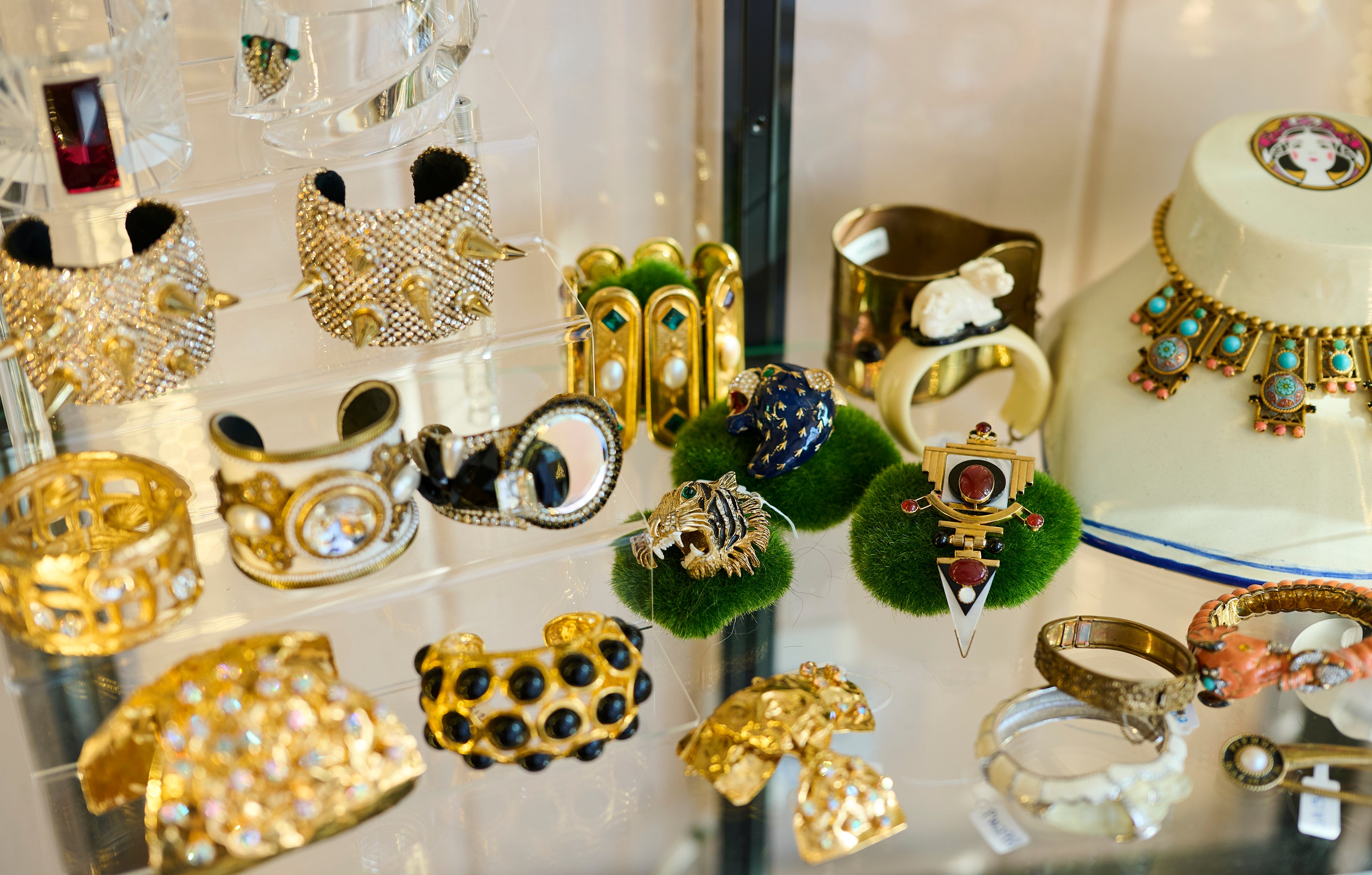
Our current Sterling Silver Collection includes everything from sculptural artisan jewelry and Modernist pieces to sterling brooches, rings, bracelets, and gemstone designs from decades past.
Because with vintage jewelry, sometimes the smallest mark on the back opens the door to the biggest story.
SHOP THE STERLING SILVER COLLECTION →